Spring Hill Root Removal from Sewer Lines: Cutting, Not Dissolving
Roots do not break sound pipe. They find a joint, a fitting or a tiny crack that seeps moisture, push in as fine hairs and then thicken. A sewer line carries water and nutrients all day, which is exactly what a root wants. Once inside, the mass catches paper, grease and wipes, and a line that was only damp becomes a partial dam. That is why roots tend to produce the same blockage again and again rather than a single event.
Symptoms are the same as any main-line trouble, only repeating: a drain that slows after each cable run, toilets that gurgle, a snake that comes out with fibrous strands.
Signs You Have Roots, Not Just Grease
Roots leave clues that other clogs do not:
- The cable stops at the same distance in the line every time
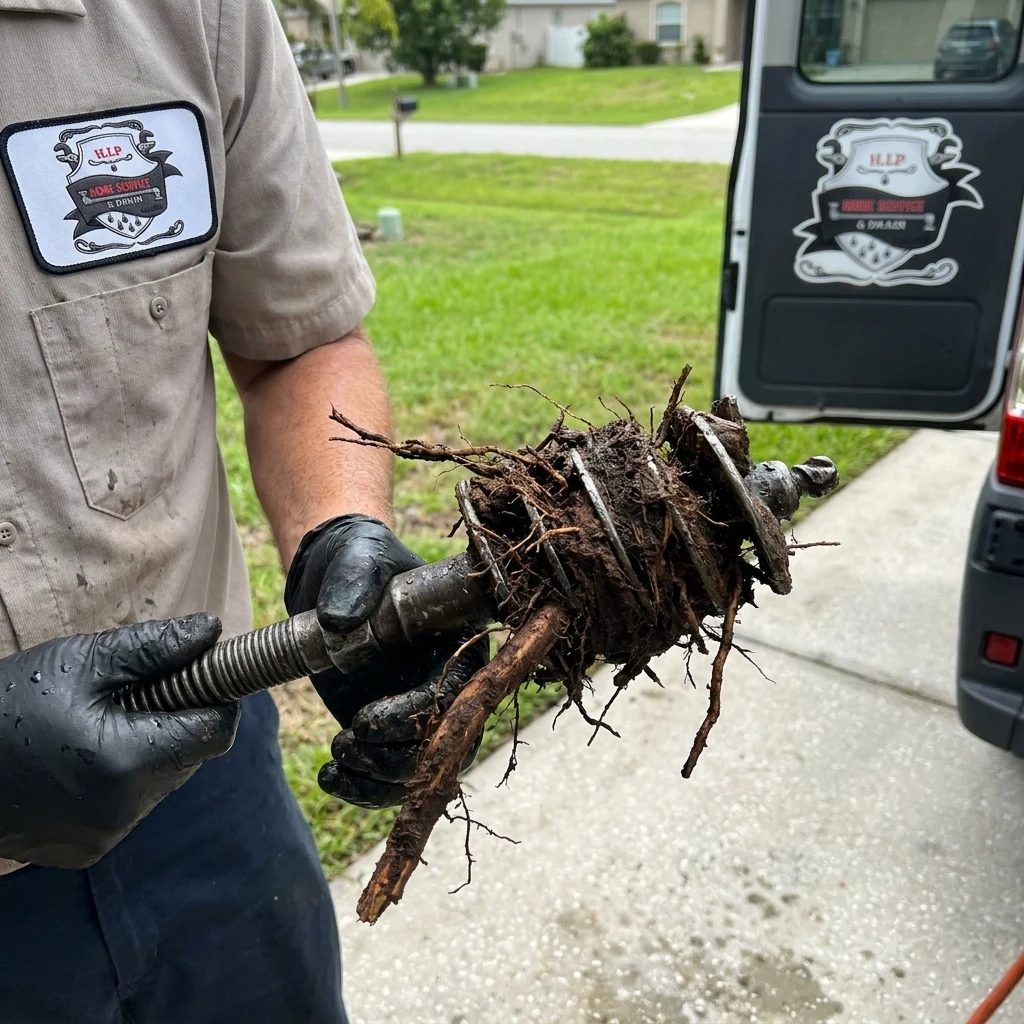
- Fibrous strands, not slime, come out on the snake
- Slowdowns that return every few weeks or months
- Gurgling when several fixtures drain together
- A mature tree or an irrigated bed close to the line path
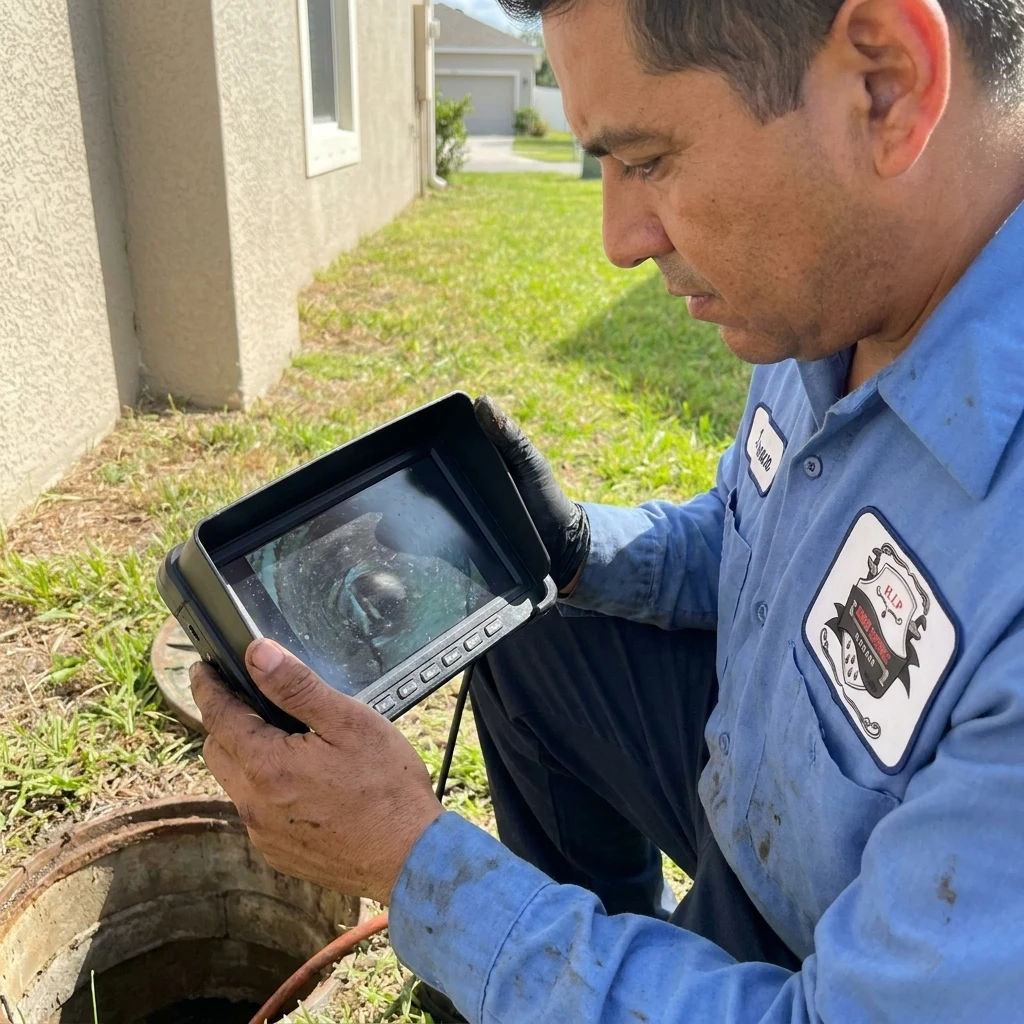
- A camera view showing a fringe of hairs or a ball of roots at a joint
- Wet ground or a soft, greener patch along the line after a dry spell
Root-Cutting Nozzles Versus Chemical Root Killers
A root-cutting nozzle spins on the jetter hose and shaves roots flush to the pipe wall, and then the line is flushed so the debris leaves instead of settling downstream. Chemical foam and crystal products are different. They aim to kill roots in place, leave the debris behind and add chemicals to a system where EPA advises against chemical drain openers on septic homes. We do not use them.
On trees we say only what we can support. Roots chase steady moisture, and Spring Hill soil data show well-drained Candler sand at several sampled communities, which suggests roots may follow irrigation toward a pipe joint. That is an inference, not a measurement. Our post on irrigated lawns and sewer lines explains the idea in more detail.
Root Clearing Prices and the Honest Limit
Main line hydro jetting with moderate roots runs $400–$750. A main line snake run is $225–$450 when a cable can do the job. If you want to see where roots enter, a camera pass is $150–$300. The price is written before we start and the estimate holds for 30 days. The cost guide shows how roots change a quote.
Cutting roots is a trim, not a cure. If the joint stays open, roots return, and how fast depends on the tree and the gap. A cutter will also not mend a cracked or offset pipe, and aggressive cutting on brittle pipe can make a break worse. When footage shows a failed joint, we say so and recommend a plumber. Tree removal is outside our work too.
Spring Hill Root Removal: Sections Where Roots Reach the Line
Roots enter at joints and cracks where a line leaks moisture, so pipe age and irrigation matter more than tree species. These sections are the likeliest starting points.
- Deltona Boulevard area — In ZIP 34606, 21.1 percent of homes date to the 1970s and 35.2 percent to the 1980s. Laterals that old have had decades for roots to find joints.
- Commercial Way and US-19 — ZIP 34607, which also covers part of the US-19 corridor, has 22.1 percent of homes built before 1980. Roots work at joints in lines nearing 40 years old.
- Weeki Wachee Woodlands — Off Apache Trl and Hiawatha Pkwy in ZIP 34606, where the median home dates to 1987. Lateral joints have had 35-plus years to open.
- Timber Pines — Homes built from 1981 to 2017, median 1992. Roots are most likely at plastic joints in the older half of the community, and a camera pass shows where to cut.
- South Brooksville Avenue — An oak-lined brick street in a National Register historic district, in a city whose first sewer dates to 1926-28. Big trees and old lines make roots a first suspect.
- Silverthorn — Its covenants allow lot wells only for irrigation, so irrigated beds sit over many laterals. That steady moisture is a likely path for roots to a joint.
- Seven Hills — The soil is Candler fine sand, about 97 percent sand and excessively drained. Roots travel far for water, and a leaking joint becomes the nearest steady source.
- Hernando Beach — Median home built 1986, and none before 1960. Laterals that are close to 40 years old are in the range where joints can open.
Roads and Landmarks Around Spring Hill Root Removal Work
- Spring Hill waterfall — At 5281 Spring Hill Dr and US-19, the 1967 entrance marks the start of the original Deltona-era grid, where laterals are oldest.
- Delta Woods Park — A 20-acre county park at 3400 Deltona Blvd with a half-mile lighted trail, a fixed reference point on the older west side.
- Forest Oaks Boulevard — Home to county offices, including the Property Appraiser at 7525 and the Health Department at 7551, in ZIP 34606.
- Pioneer Park — At 6799 Pinehurst Dr, another fixed reference point on the west side of Spring Hill.
- Hunters Lake — A 302-acre lake with a boat ramp at 1202 Kenlake Ave, on the west side of Spring Hill near US-19.
- Weekiwachee Preserve — An 11,206-acre preserve on the Gulf side. Coastal Weeki Wachee and Hernando Beach lots sit nearby.
- South Brooksville Avenue Historic District — Roughly Liberty Street to Early Avenue in Brooksville, with oak-lined brick pavement and homes from the Queen Anne to the Bungalow era.
Root and Soil Numbers Behind Spring Hill Root Removal
- Roots were behind 22 percent of reported sewer blockage events in EPA’s 2004 Report to Congress, with another 4 percent split between roots and grease. EPA notes roots penetrate weaknesses at joints and stress points, so where the roots got in matters as much as how much was cut.
- A University of Georgia Extension article says sewer and septic lines attract roots with a constant supply of water and nutrients. A line that always carries water is an easy target for a thirsty root, which is why a tight joint matters more than the tree beside it.
- USDA soil data at Seven Hills, Silverthorn, Sterling Hill and Pristine Place lists Candler fine sand, excessively drained, about 97 percent sand. Water drains away fast in that soil, so a leaking joint is a steady wet spot for roots and shows nothing at the surface.
- Only 12.5 percent of Spring Hill homes predate 1980, compared with 18.6 percent across Hernando County, in the 2020-2024 American Community Survey. Most local laterals are probably plastic, so roots more often work at joints in plastic pipe than in crumbling clay.
- A 2001 review in the Journal of Infrastructure Systems, by Randrup, McPherson and Costello, says smaller pipes commonly need root clearing at one- or two-year intervals. A home lateral is a small pipe, so a cleared line can need cutting again, and we say that up front instead of promising permanence.
Roots found on camera, or just suspected?
Either way, the first step is the same: a camera pass to see where they enter. Call and we will explain the order of the visit, the cut and the wash behind it.
CALL 813-733-7188Lines Where Roots Show Up
Root cutting is requested most for yards and laterals in Brooksville, Hernando Beach, Ridge Manor, Shady Hills, Seven Hills, Silverthorn, Pristine Place, Mariner Boulevard, Deltona Boulevard and Commercial Way (US-19). The camera pass is how we know which joint roots entered, and you keep the video.
Root Questions Worth Asking
They enter at joints, fittings or small cracks where moisture seeps out, then grow as thin hairs and thicken inside. A sound, tight pipe is hard to enter. That is why a camera pass helps show which joint is the weak point.
They can kill live root tissue, but they leave the dead mass in the pipe and add chemicals to your system. EPA advises against chemical drain openers on septic homes. Mechanical cutting followed by a flush removes the roots rather than waiting for them to die.
It varies. A tight joint with a distant tree may stay clear for years, while an open joint near irrigation can see regrowth within months. A camera before and after shows what we cut and where it came from, so you can judge.
We cannot name species with confidence, and no local survey says. What we can say is that mature trees and irrigated beds near the line path raise the odds. A camera shows whether roots are present, and the footage matters more than a guess.
Yes, in the stretch between the house and the tank. We do not jet the tank or the drainfield. If roots have reached the tank or the field, that is a licensed septic contractor’s job.
Pair Root Cutting With
Sewer Line Hydro Jetting
Once the roots are cut, the full run to the street or tank is washed so the pieces do not catch paper.
Sewer Camera Inspection
Shows which joint the roots entered and whether the pipe is sound enough to cut at all.
Hydro Jetting Services
Background on pressure and nozzles, including why cutting and washing are two separate passes.